Do UK online sellers need to accept returns?
Rights depend on the transaction and reason. Review current official guidance and ensure the store policy meets applicable obligations.
ecommerce returns management UK
UK ecommerce returns management needs both a customer-compliant process and an economical local operation.
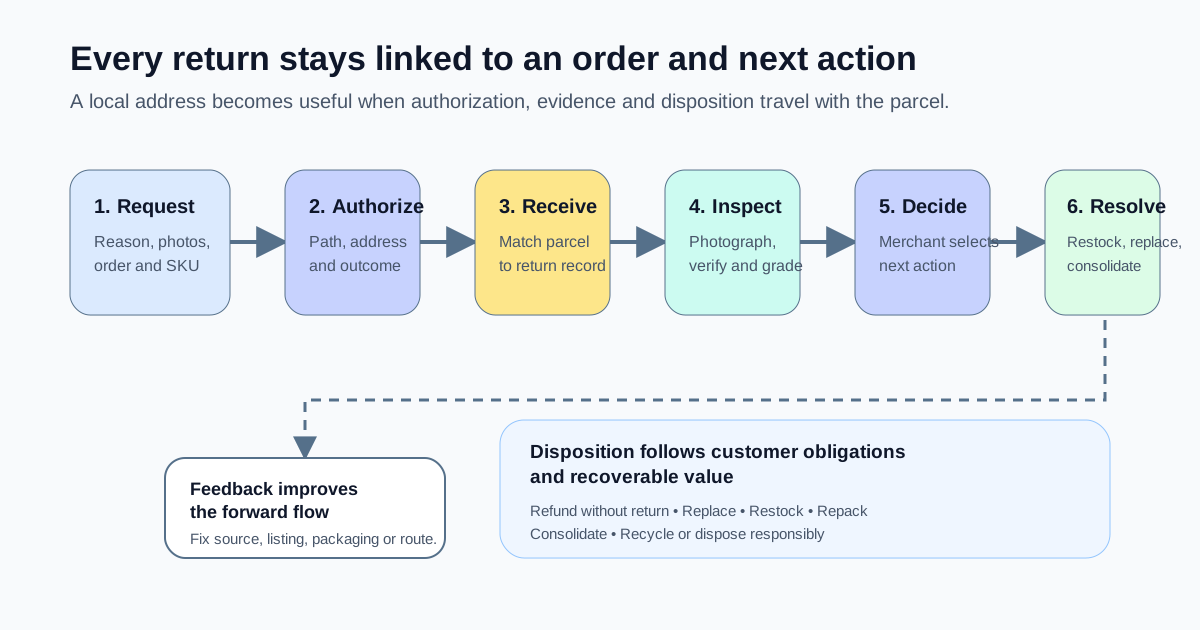
Authorise the return, link it to the order, receive it at an approved address, document condition and choose restock, replacement, consolidation or disposal.
A UK address improves the experience only when the workflow behind it is controlled.

Section 1
Cancellation, faulty goods and voluntary change-of-mind terms can create different responsibilities. Review current GOV.UK and CMA guidance and obtain advice where necessary. The merchant decides the customer resolution under the applicable policy and law; the receiver documents the physical facts. If this needs to become a real operating process, map the order-linked returns workflow with ProveedorPro.
Section 2
Record merchant, order, SKU, reason, evidence, expected parcel, address and promised outcome. Provide the customer with clear instructions. The UK receiver checks expected arrivals and flags unknown parcels. This prevents personal addresses and storage spaces from becoming uncontrolled inventory. For the next part of the decision, review Dropshipping UK: build the operation behind the offer.
Section 3
Capture label, outer package, exact item, accessories, seal and visible damage. Apply merchant-defined grades and isolate uncertain or unsuitable goods. The operator should not restock hygiene-sensitive, unsafe or mismatched products simply because the box looks tidy.
Section 4
Compare local restock or resale, repacking, replacement, consolidation to China or another hub, recycling and disposal. Include handling, storage and outbound transport. Low-value products often justify replacement or refund, while recoverable items may support inspection and consolidation. Set a merchant response deadline so the operator is not forced to store undecided goods indefinitely, and define the escalation before the pilot begins. This also connects directly to Dropshipping suppliers UK sellers can verify product by product.
Section 5
Track reasons by SKU, supplier and listing. Size confusion may require copy changes; transit damage may require packaging; repeated defects may require source replacement. Return data improves forward margin only when it reaches product and supplier decisions. When the receiving scope and destination are clear, request a returns-pilot review.
Section 6
ProveedorPro can connect an order-marked return concept with UK local receiving and China-side sourcing/fulfillment. The pilot should cap product risk and storage, document service time and economics, and expand only after real merchant demand shows which capabilities matter. Measure authorization-to-arrival, receive-to-evidence, merchant decision time, recovered value and source corrections. Review the operator whenever product scope, monthly volume or accumulated inventory value crosses the agreed pilot limits.
Run this final operating check with the exact SKU and destination. A supplier badge or successful app connection does not replace product-level verification.
Verify current platform, trade, consumer or quality requirements before making a customer promise. Product and destination rules can change.
Rights depend on the transaction and reason. Review current official guidance and ensure the store policy meets applicable obligations.
A controlled pilot may use a trained receiver for suitable low-risk goods, with authorization, privacy, storage and disposition controls.
Not automatically. Compare local receiving, replacement, refund and consolidation against product value and customer obligations.
It should verify the expected SKU, accessories, seal or use, visible condition, package condition and merchant-defined grade with photos.
Share the destination, expected parcel volume and product types so the receiving, evidence, storage and disposition workflow can be reviewed together.