Dropshipping sourcing agent: scope, fees and fit checklist
A dropshipping sourcing agent helps a seller turn a product idea, ad angle or competitor reference into a supplier-ready operating brief.
The broad job is not limited to one country or marketplace: the agent should clarify the exact product, compare source options, price the route, define fulfillment handoffs and reduce the gap between the offer you advertise and the parcel your customer receives.
Continue with the Ireland-specific version of this decision
Ireland changes the destination, EUR planning context, Revenue/VAT questions, consumer obligations and applicable EU product-safety checks. Use the localized owner page rather than treating another English-speaking market as interchangeable.
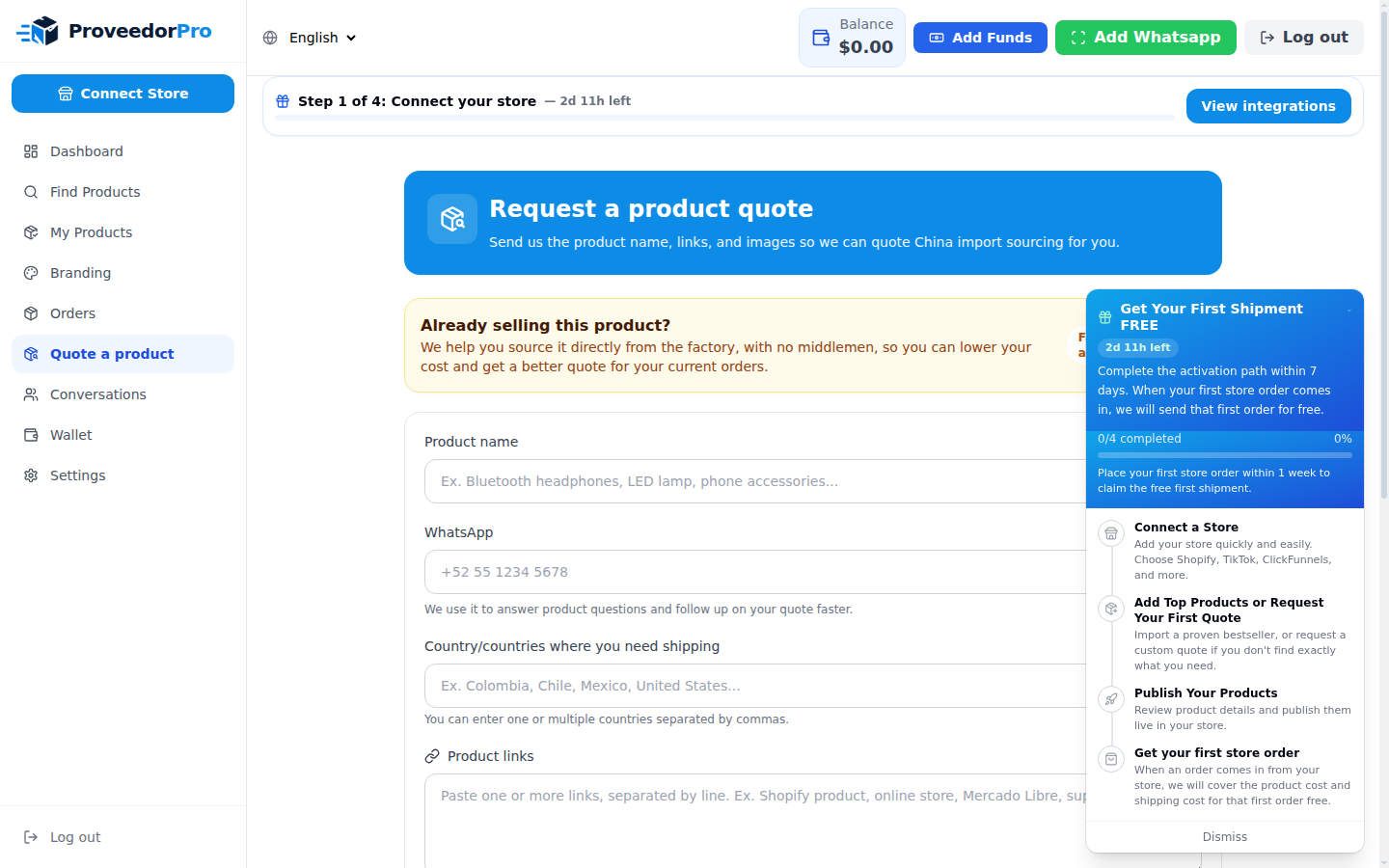
A practical supplier decision connects product evidence, landed margin, order handling and delivery—not a listing alone.ProveedorPro workflow evidence: A useful sourcing-agent brief begins with the exact product, destination and operating requirements—not a vague request for the cheapest source.
Section 1
The broad agent job: from offer idea to operating brief
A useful agent starts before a purchase order. They help translate a selling angle into specifications: target customer, reference product, acceptable materials, dimensions, variants, packaging, destination, expected selling price and order pattern. That brief lets the agent compare sources fairly instead of returning one cheap listing that may not match the product in your ads. If you are planning this model for your market, see how ProveedorPro connects sourcing and fulfillment.
Define the exact product and acceptable substitutions
Separate product, packing, handling and route assumptions
Create a quote brief that suppliers can answer consistently
Flag products that look good in ads but are fragile, oversized or difficult to support
Agent, supplier, catalog platform or fulfillment partner?
A supplier sells its own or represented products. A catalog platform organizes listings and may automate store tasks. A sourcing agent works from your product requirement and can search beyond a fixed catalog. A fulfillment partner receives orders, prepares parcels and returns tracking. One company can play several roles, but the seller should know which role is being promised for this product. A dashboard is useful; accountability for the exact SKU is more important. For the next part of the decision, review Dropshipping: build a store that can source, fulfill and scale.
Send reference links or photos, intended use, materials, dimensions, acceptable variants, destination, expected retail price, packaging needs and the first order scenario. Ask every candidate to return the same fields: product cost, sample path, packed weight, processing time, shipping option, handling fees, defect process and what evidence you receive. Without a shared format, you are not comparing agents; you are comparing different levels of uncertainty.
Agents may charge a service percentage, fixed handling fee, margin inside the product quote, fulfillment fee or a combination. Ask when each fee applies and whether it changes after samples, storage, custom packaging or higher volume. Compare total landed cost and included work. The cheapest sourcing fee is not automatically the cheapest operation if inspection, repacking, consolidation or exception handling appears later as separate charges. This also connects directly to Dropshipping suppliers: choose for margin, quality and delivery.
Start with one tightly specified product. Compare at least two source options. Request a sample and packed measurements. Review response quality when you ask an awkward question, not only during the sales pitch. Confirm payment entity and refund terms. Test tracking and packaging with a real destination. Finally, document escalation contacts and the evidence required for a damage, shortage or wrong-variant claim. When you have a product candidate, request an exact sourcing and route review.
When ProveedorPro fits this broad sourcing-agent job
ProveedorPro fits sellers who have a product idea, listing, creator reference or competitor offer and need product-specific sourcing plus a route they can price before scaling. The strongest fit is a seller serving Mexico or Latin America who wants operating numbers - source, variant, packing, route, delivery range and margin - before spending heavily on ads. For China-specific marketplace and factory search, use the dedicated China sourcing agent guide next. For the operational handoff, continue with China sourcing agent for dropshipping: 1688, samples and route control.
Run this final operating check with the exact SKU and destination. A supplier badge or successful app connection does not replace product-level verification.
Approve the exact variant, specification, package contents and product evidence.
Calculate landed cost with packing, fulfillment, route, fees, acquisition and expected exceptions.
Test a sample or low-risk live order through the destination customers will actually use.
Confirm inventory, processing, tracking, cancellation, defect and replacement procedures.
Align the product page, delivery range and return language with the tested workflow.
Document the approved source and keep a qualified backup for any critical SKU.
Authoritative resources
Verify current platform, trade, consumer or quality requirements before making a customer promise. Product and destination rules can change.
Search for agents with experience in your product type, destination and fulfillment model, then test them with a written brief, comparable quotes, a sample and a small live shipment before committing more volume.
Do dropshipping sourcing agents require minimum orders?
Some support individual orders while others require daily volume, prepaid stock or minimum purchasing. Ask separately about sourcing minimums, warehouse minimums and fulfillment minimums.
Can a sourcing agent connect to Shopify or another store platform?
Some agents provide apps or order integrations; others work through CSV, API or manual order submission. Verify the exact order, tracking, cancellation and variant workflow before assuming an integration is complete.
Who owns the supplier relationship?
It depends on the agreement. Ask whether supplier names and factory details are disclosed, whether you can transfer the relationship and what happens to samples, molds, packaging files or prepaid inventory if you leave.
Should I pay an agent before receiving a sample?
A sample normally requires payment for the item, handling and shipping. Use a traceable payment method, confirm the recipient entity and avoid committing large inventory funds before the product and process are verified.
Turn a dropshipping idea for your market into operating numbers
Share a product link, photo or description so the source, product details and available fulfillment route can be reviewed together.