Shopify dropshipping suppliers Singapore: evaluate product mapping before you commit
Shopify dropshipping suppliers Singapore starts with one exact product, a Singapore destination and a documented operating plan.
Compare product mapping, order handoff, tracking return before publishing a customer promise.
ProveedorPro coordinates supported China-side sourcing and fulfilment; the seller remains responsible for applicable Singapore GST, import, product-safety and customer obligations.
A Singapore-focused decision map connecting product evidence, China-side operations, GST and import checks, fulfilment and a quote-ready next step.ProveedorPro workflow evidence: A product-specific quote connects the search intent to an exact SKU, destination, cost and operating route.
First-party evidence selected for this buyer job
What the operation can show before you commit
These ProveedorPro-owned assets are mapped to this page because they support its specific decision. They show observable workflow evidence; they do not guarantee a future supplier, cost, quality result, customs outcome or delivery time.
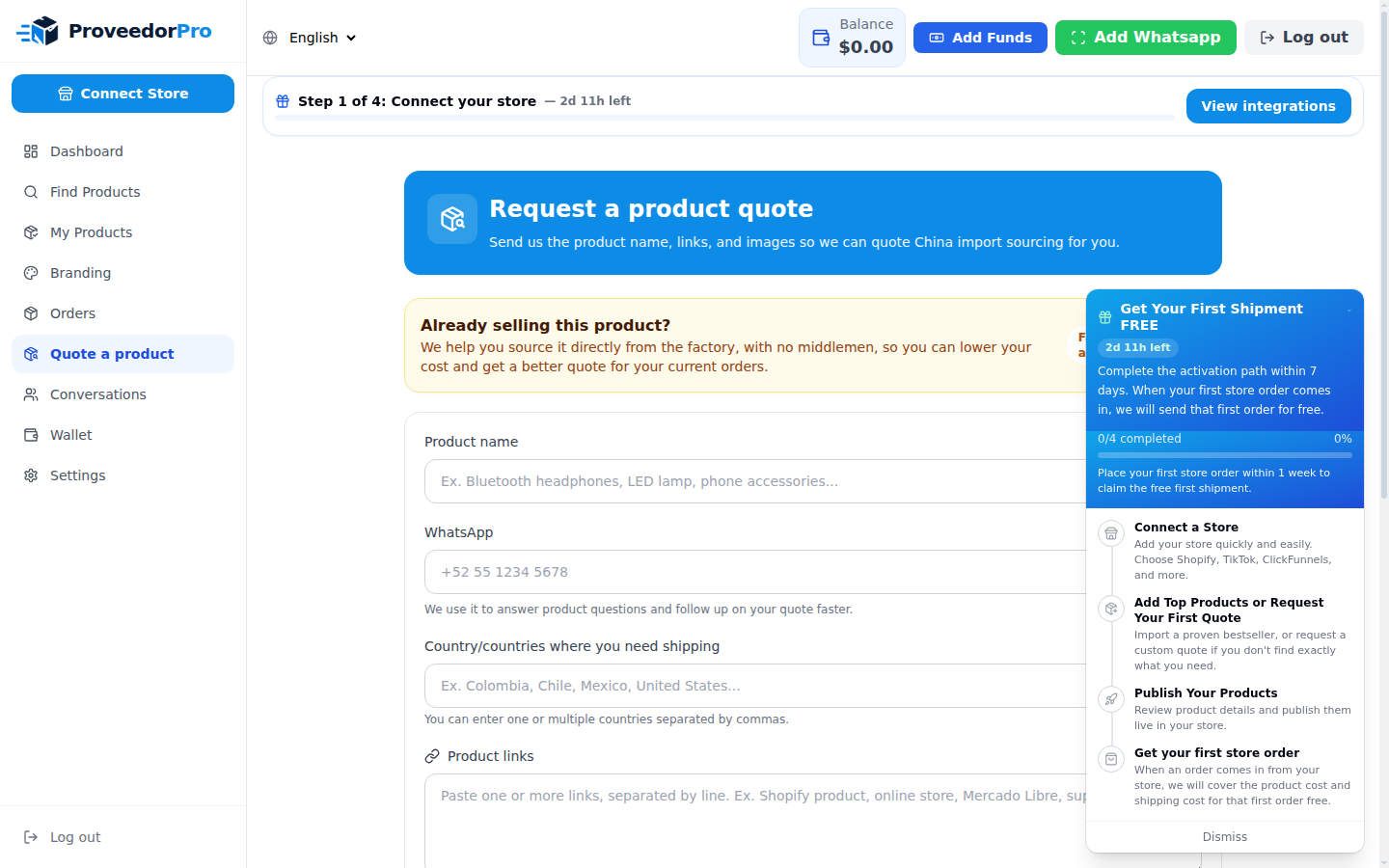
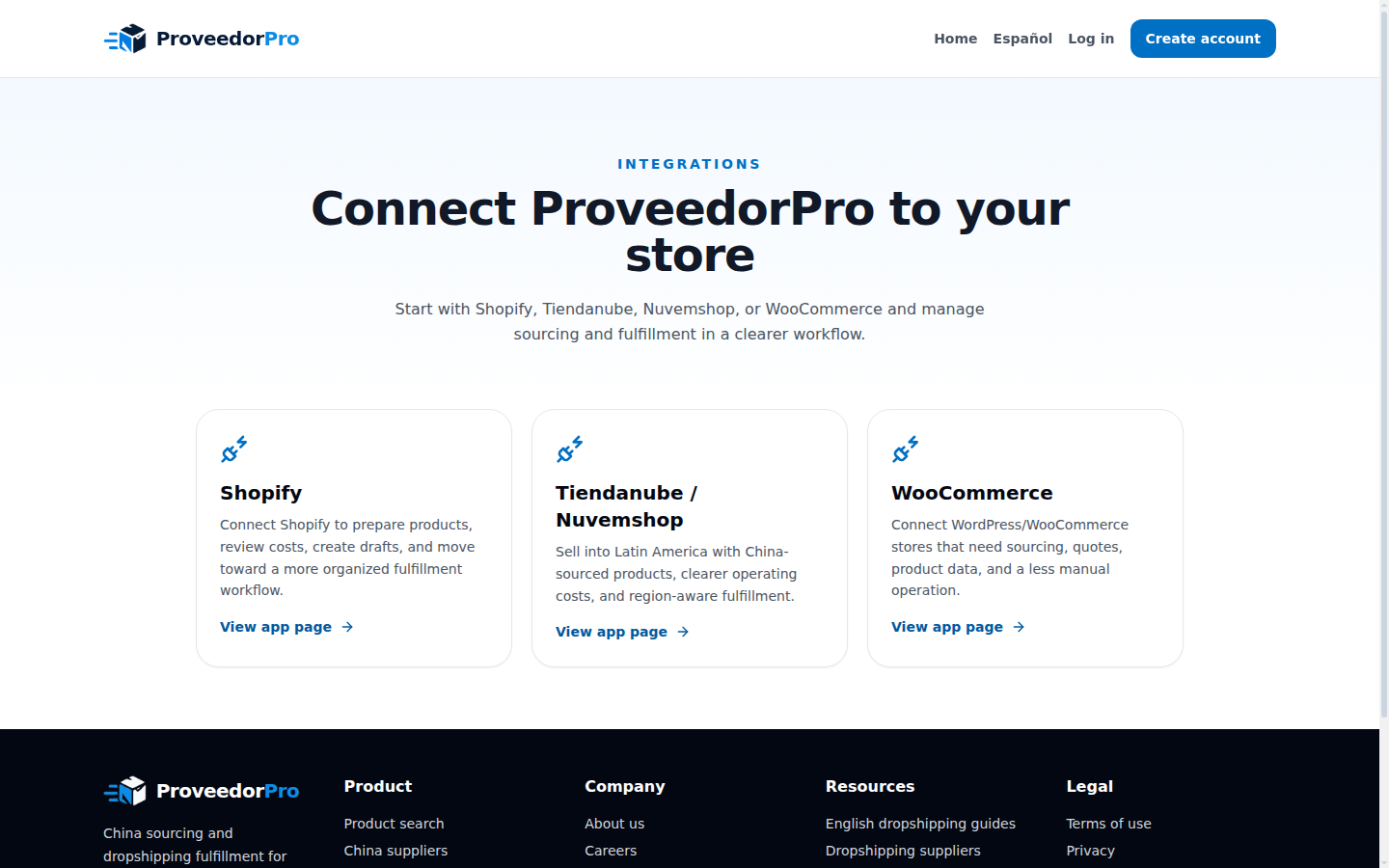
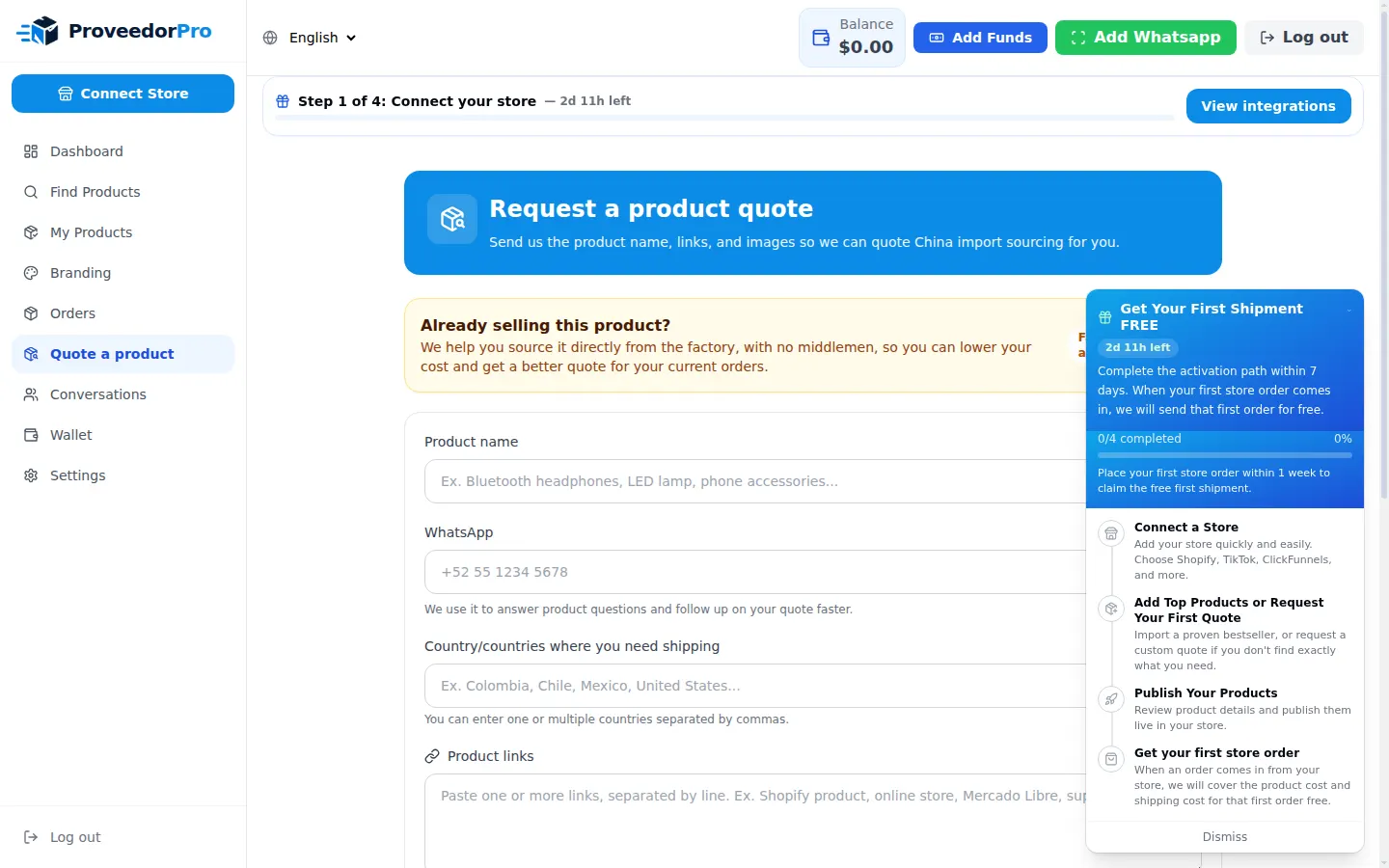
ProveedorPro integrations view. the English integrations view used to connect store and order workflows. It supports the product mapping decision for this page; it is operational evidence, not a delivery, cost or quality guarantee. ProveedorPro-owned first-party asset.ProveedorPro quote workflow. a product-specific quote workflow with product and fulfilment inputs. It supports the order handoff decision for this page; it is operational evidence, not a delivery, cost or quality guarantee. ProveedorPro-owned first-party asset.
ProveedorPro operational evidence
Order intake, packing and labeling
New orders move into packing and labeling as part of the fulfillment handoff. This is ProveedorPro-owned footage selected from the canonical operational video library for this specific workflow.
Decision supported: The store-order-to-warehouse handoff.
First-hand evidence mini-case
Evidence mini-case: a store-order-to-warehouse handoff
Input: Buyer job: Choose a supplier workflow for a Singapore Shopify store. The evidence was selected to test Shopify supplier operations, not to stand in for a Singapore-specific quote or delivery record.
Observed: What the owned asset shows: orders entering packing and labelling after the digital intake step.
Decision: Decision supported for Shopify dropshipping suppliers Singapore: test SKU mapping, address data, status updates and tracking return with a controlled order.
Still to verify: What remains unproven until a live product is reviewed: platform permissions, seller-specific automation, exception handling and Singapore delivery performance.
A reviewed still from the same ProveedorPro-owned operation, placed here because it visibly supports this page's fulfillment decision.
Section 1
Shopify dropshipping suppliers Singapore: the direct answer
Shopify dropshipping suppliers Singapore starts with one exact product, a Singapore destination and a documented operating plan. Compare product mapping, order handoff, tracking return before publishing a customer promise. ProveedorPro coordinates supported China-side sourcing and fulfilment; the seller remains responsible for applicable Singapore GST, import, product-safety and customer obligations. To connect this requirement to a real store workflow, review ProveedorPro’s integration path.
Buyer job: Select and start a paid Shopify dropshipping suppliers Singapore workflow for a Singapore ecommerce business.
Decision boundary: Merging with aliexpress-alternative would remove this buyer job's distinct provider-selection criteria, proof requirement and conversion handoff.
Start with a product URL or specification, exact variant, quantity, destination postal code and required evidence.
Map product mapping as a chain of custody. Identify who receives the instruction, who touches the product or data, what record is created, and who can stop release. Then test the weakest transition with a sample or trial order. In a Shopify dropshipping suppliers Singapore engagement, that map should yield a clear product mapping pass/hold record with an accountable owner while exposing handoffs that would otherwise disappear between supplier, warehouse and store. For the next part of the decision, review dropshipping suppliers Singapore: evaluate supplier model fit before you commit.
Evidence needed: dated proof for the exact variant and stated scope.
Decision owner: the person allowed to approve or stop the next step.
Failure test: the condition that triggers a hold or corrective action.
Test order handoff with a small, reversible step before scaling Shopify dropshipping suppliers Singapore. Ask what happens when the variant is unavailable, the parcel exceeds the quoted profile, the inspection fails or tracking does not update. Record the response time, authority and remedy for each exception. The result should be a clear order handoff pass/hold record with an accountable owner, supported by dated product-level evidence rather than a platform badge.
Commercial boundary: included and excluded work shown separately.
Comparison basis: the same SKU, quantity, packing and destination.
Review trigger: any material product, supplier, route or platform change.
Run a controlled trial for tracking return before relying on it in customer-facing promises. Use one representative SKU and trace the work from request through approval, exception handling and handoff. Note every manual intervention, missing datum and changed charge. For Shopify dropshipping suppliers Singapore, a successful trial creates a clear tracking return pass/hold record with an accountable owner and a repeatable instruction for the next order. This also connects directly to Dropshipping suppliers: choose for margin, quality and delivery.
Handoff input: the record the next operator must receive.
Exception path: owner, response and customer remedy.
Scale proof: a successful test order or evidence review before volume increases.
This page is scoped to the paid buyer job “Select and start a paid Shopify dropshipping suppliers Singapore workflow for a Singapore ecommerce business.” and the platform-integration format observed in the Singapore research package completed on 1 October 2026. It uses Singapore Customs and IRAS as primary references for import and GST context. Competitor structures informed the questions and decision modules, but their wording was not copied. Product, supplier, route and tax outcomes remain dependent on the live SKU and transaction. Once the product and platform requirements are defined, request a product-specific quote.
the store-to-supplier workflow fits a seller whose goal is to verify the physical workflow behind the app connection before adding catalogue or ad volume the catalogue. It is particularly useful when evidence about product mapping, order intake, fulfilment status and tracking return affects conversion, margin or retention. It may be unnecessary for a very early research idea with no validated product, and it may be the wrong route when the category requires capabilities, certification or local infrastructure that have not been confirmed. Use a store-to-supplier handoff map to make the boundary visible. The right answer is a scoped pilot, not forced certainty. The page-specific checkpoint in this section is product mapping; record its owner and dated proof before advancing.
Good fit: a defined SKU, real customer market and willingness to test.
Needs more research: vague product, unknown materials or unsupported claims.
Hold: prohibited product, missing critical documentation or no viable route.
Scale only after the product mapping evidence and order workflow survive a real pilot.
Before publishing or increasing spend for the store-to-supplier workflow, confirm that the product page, Shopify supplier operations record and fulfilment plan describe the same item. Check variant naming, package contents, dimensions, instructions, warnings, inventory method, processing time, tracking event, delivery range and customer remedy path. Save the approved evidence and assign a backup plan for a source, route or operational failure. This checklist is deliberately operational: traffic cannot rescue a product whose physical workflow is still a group chat and a hopeful emoji. The page-specific checkpoint in this section is order handoff; record its owner and dated proof before advancing.
Exact SKU and specification approved.
Supplier, sample and quality evidence stored.
SGD landed-cost scenario reviewed.
Singapore Customs and IRAS import and GST guidance, Singapore consumer-protection authorities and Singapore product-safety questions checked with authoritative guidance.
Test order and exception path completed.
Store claims, delivery range and support policy aligned.
For the store-to-supplier workflow, the store still owns the promise made to its Singapore customer. The Singapore consumer-protection rules apply to online sales, including product conformity, remedies and cancellation rights. That makes evidence about product mapping, order intake, fulfilment status and tracking return part of the decision, not an afterthought for support. Define how a defect is documented, who reviews it, when a replacement or refund is approved and what happens to the physical item. The order handoff agreement should support the store promise; it should not force the customer to discover the supply chain during a complaint. The page-specific checkpoint in this section is order handoff; record its owner and dated proof before advancing.
Write product claims from verified specifications and test evidence.
Keep order, batch, inspection and tracking records connected.
Define replacement, refund and supplier-recovery procedures.
Use customer-facing delivery and return language the tested route can support.
Run this final operating check with the exact SKU and destination. A supplier badge or successful app connection does not replace product-level verification.
Approve the exact variant, specification, package contents and product evidence.
Calculate landed cost with packing, fulfillment, route, fees, acquisition and expected exceptions.
Test a sample or low-risk live order through the destination customers will actually use.
Confirm inventory, processing, tracking, cancellation, defect and replacement procedures.
Align the product page, delivery range and return language with the tested workflow.
Document the approved source and keep a qualified backup for any critical SKU.
Authoritative resources
Verify current platform, trade, consumer or quality requirements before making a customer promise. Product and destination rules can change.
How should a Singapore seller evaluate Shopify dropshipping suppliers Singapore?
Start with one exact product and compare product mapping, order handoff, tracking return on the same scope. Keep every price, sample, inspection and route assumption dated.
Does ProveedorPro guarantee delivery times for Shopify dropshipping suppliers Singapore?
No. Delivery depends on the product, packed parcel, current route, customs and last-mile handoff. A live quote should state its assumptions and validity date.
How should GST be handled for orders sent to Singapore?
Singapore GST treatment depends on the transaction, seller or marketplace registration, item value and import route. Check current IRAS and Singapore Customs guidance for the actual order.
What evidence should be collected before scaling Shopify dropshipping suppliers Singapore?
Keep the approved specification, supplier comparison, sample or inspection evidence, packing details, route quote, tracking test and exception owner together.
What is the next step with ProveedorPro?
Submit the product link or specification, exact variant and Singapore destination. ProveedorPro can scope the supported China-side sourcing, evidence and fulfilment work.
Build a platform workflow for Singapore around one real product
Bring the product link and destination so the supplier, integration, fulfillment and landed-cost assumptions can be reviewed together.